Movie Review: ‘Napoleon’

Plot: Acclaimed director Ridley Scott’s latest chronicles the exploits of Napoleon Bonaparte (Joaquin Phoenix). Beginning with his time as a young army officer during the French Revolution and continuing on through his rise to Emperor of France, and eventual downfall and exile to St. Helena, the film focuses more on the war exploits of one of the greatest military minds of all time. Set against this backdrop is Napoleon’s relationship with his great love Josephine (Vanessa Kirby), one that proves to be passionate, turbulent, and toxic.
Review: In an era where the Hollywood blockbuster becomes more and more reliant on sub-standard CGI with each passing day, and saddled with ridiculously bloated budgets, I thank God for Ridley Scott. At eighty-six he’s more passionate, honest (to a fault), and authentic than directors half his age. Alien, Blade Runner, Thelma & Louise, Gladiator, and Kingdom of Heaven are some of the best films of the past fifty years, and Scott’s been at the helm for them all.
Despite being one of the most significant and important European figures of all time, Napoleon’s exploits on the big screen have been relatively sparse. Aside from Abel Gance’s 1927 silent epic (clocking in at a whopping 330 minutes) there really haven’t been any biopics of note. Stanley Kubrick labored to get a Napoleon film off the ground for years but died before it came to fruition. Friend Steven Spielberg is said to be developing a limited series based on Kubrick’s work, but it’s still in the early stages.

It seems inevitable that a director like Ridley Scott would tackle this subject matter, given his pension for historical epics and talent for bringing large battles to the big screen. Unfortunately, while Ridley Scott was probably the best director for the job, Napoleon proves to be a colossal misfire, burdened by a poor script, a muddled narrative, and some truly ridiculous moments.
I’ll start with the positives. When I said Scott was the best director to tackle historical epics, I meant it. He directs the large battles with a seasoned eye that’s reminiscent of Cecil B. DeMille and Stanley Kubrick at their best. There’s a raw and unadulterated viciousness that permeates each battle whether it’s the Siege of Toulon involving war machines and grappling ladders or Napoleon’s doomed campaign at Waterloo against Field Marshall Arthur Wellesley (Rupert Everett), the first Duke of Wellington. It’s visually stunning, with long-time cinematography partner Dariusz Wolski providing some excellent work. While there’s some VFX work at play, for the most part, Scott chooses to use hundreds of extras and real horses. The calvary charges are authentic and visceral. Authenticity, I’ve found to be the prevailing coin of the realm in cinema as of late. The Battle of Austerlitz was particularly harrowing, especially the portion where cannonballs were fired into the frozen lakes causing soldiers to drown–even if the number of casualties due to that maneuver was historically inaccurate.
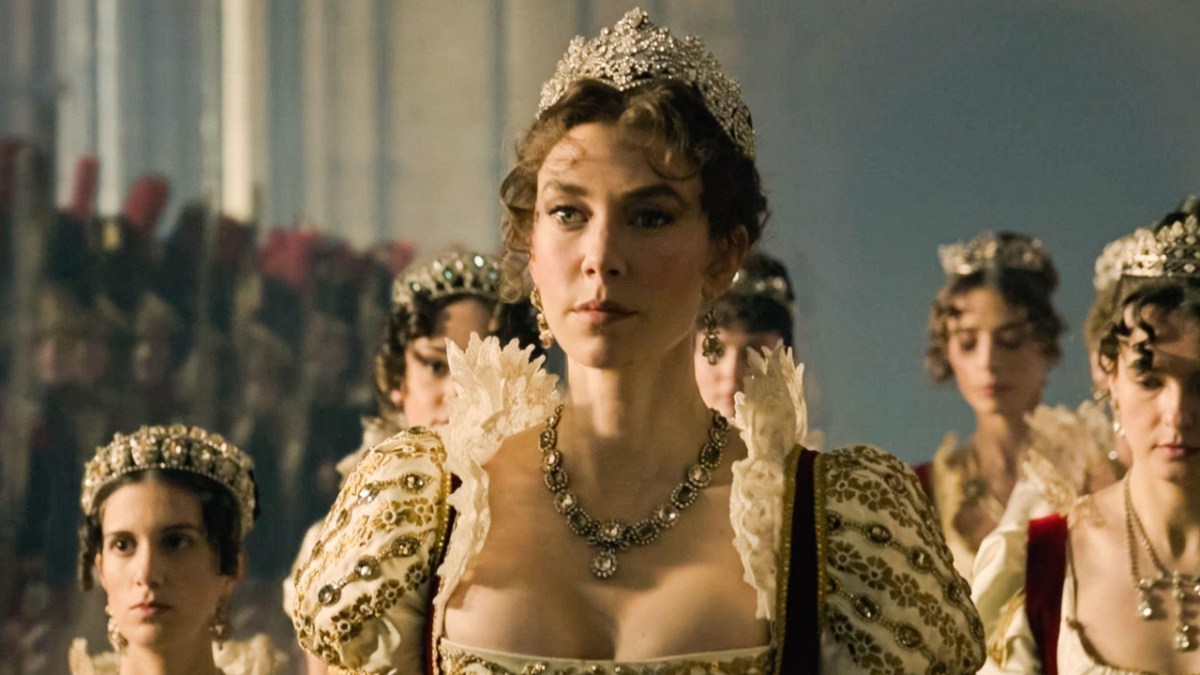
Additionally, the costume and production design of Napoleon are flawless. Costume designers Janty Yates and David Crossman clearly did their research, to the point that I wonder if they had a magical time-traveling closet they pulled these costumes out of. There’s also clear progression in terms of style as the film takes place over a period of almost thirty years. Production designer Arthur Max and set decorator Elli Griff do a fantastic job of bringing late 18th century and early 19th century France to life. I was stunned by the luxurious balls and government meetings that seemed ripped right out of the past. I have no doubt all the aforementioned people will be nominated in their appropriate categories come Oscar time.
Napoleon’s downfall lies with the script. While screenwriter David Scarpa certainly knows how to craft a battle scene, the rest of the film falls flatter than a crepe. Some of the dialogue in this film is laughably bad. I am astonished that lines like “You think you’re so great because you have boats!” and “Destiny has brought me this lambchop” were allowed to remain in this movie and are delivered with complete earnestness. Equally asinine are the sex scenes between Josephine and Napoleon. It’s like they were written and blocked by a twelve-year-old boy. Not only do they lend ammunition to the ridiculous “no sex in movies” rabble, but they make me wonder if the principals behind Napoleon have ever actually had sex, something I know to be a statistical impossibility. That’s how egregious these scenes are.
Which brings me to the performances in Napoleon. While Joaquin Phoenix gives it his all in the title role (I’ve never seen him phone in a performance and never expect him to) he’s woefully miscast. Maybe it’s his American accent, maybe it’s his vacillation between stoic and stalwart military man and petulant man-child, maybe it’s the way he sits astride a horse—I don’t know. What I do know is that it didn’t work for me. His chemistry with Vanessa Kirby I found to be lacking as well. Speaking of Kirby, she delivers a solid performance as Josephine and leans into their toxic relationship, however, I left wanting more. I had a sense that Scarpa and company were only scraping the surface of Josephine.
The editing and score come off scattershot as well throughout Napoleon. Scenes transition from languid to frenetic with no distinct pattern. For example, there’s a scene where Napoleon berates and belittles Josephine, only to be followed up with a scene where the complete opposite happens. There’s no context for why this occurs, and it feels jarring. Indeed, I felt at times that multiple scenes were missing. (Yes, I’m fully aware there’s supposed to be an upcoming four-hour cut. However, based on what I’ve seen I have no desire to waste my time.) To be fair I attribute the disjointed nature of Napoleon to Scott rather than Academy Award winner Claire Simpson and co-editor Sam Restivo, but it’s definitely lacking. Weirdly, the disjointed nature of the editing pairs with Jack Phipps bizarre score. He doesn’t seem able to pick a lane, with the music at times rousing and reminiscent of Amadeus, while other times being strangely ominous and synth-like.

Moreover, I want to address the historical aspects of Napoleon. More accurately, I want to address this film as a robust depiction of the man’s life. In short—it isn’t. Listen I understand that you’re only going to be able to hit the highlights in a film that’s slightly over two and a half hours, but this movie is wildly one-sided and sometimes inaccurate. I don’t expect anyone’s notion of history to rest solely on the shoulders of popular films (if so, the school system has failed you) but I expect more out of Ridley Scott. The military and occasionally tyrannical side of Napoleon gets the most play. We never see the stoic, the philosopher, the champion of meritocracy, the progressive who promoted religious tolerance and codified into law democratic principles that exist to this day. I mean there’s a scene where Napoleon leaves a battle because he hears Josephine is having an affair. Not only did this not happen but Napoleon was known for his uncanny ability to compartmentalize his personal, public, and work life. (Incidentally, if you want an excellent recount of the man’s existence, go read Andrew Robert’s Napoleon: A Life.) If Ridley Scott’s intention was to provide a balanced, nuanced, and thorough depiction of Napoleon’s life, he failed miserably.

Ultimately, Napoleon proves to be a rare misfire for director Ridley Scott. While the battle scenes, production design, and costumes are excellent, there’s little to enjoy about the rest of the film. I still believe the definitive cinematic depiction of Napoleon Bonaparte’s life is possible.
This just isn’t it.
1 God Awful Blind Yourself With Acid Bad
2 Straight Garbage
3 Bad
4 Sub Par
5 Average
6 Ok
7 Good
8 Great
9 Excellent
10 A Must See
Napoleon: 5/10


![Top 10 Creepy Cryptids [by Bea Harper]](https://i0.wp.com/houseofgeekery.com/wp-content/uploads/2016/10/cryptid.jpg?fit=1200%2C675&ssl=1&resize=40%2C40)


