Movie Review: ‘Joker: Folie à Deux
Director: Todd Phillips
Cast: Joaquin Phoenix, Lady Gaga, Brendan Gleeson, Catherine Keener, Zazie Beetz, Steve Coogan, Harry Lawtey, Leigh Gill, Sharon Washington
Plot: Arthur Fleck is confined to Arkham Asylum while awaiting trail when he meets Lee Quinzel, an obsessed fan. The two fall in love, and Lee looks to manipulate the situation to allow them to have a life together.
Review: We saw Joker when it first released among societal fears of its deadly influence and found it to be…fine. Nothing we hadn’t seen before but elevated by an incredible performance by Phoenix. It was the sequel that really piqued our interest, adding the fan favourite character Harley Quinn played by Lady Gaga with a musical angle. Sounds unique and interesting. So we sat down to watch and it opened with a classic WB animation…but it’s about Joker instead of a Looney Tunes character. What this contributes to the movie is unclear. It doesn’t have a link to the story, it doesn’t introduce anything thematically, it doesn’t serve as an introduction to the musical style sequences of the film, which we suspected it may have been, but it just exists because it’s quirky and Joker. There’s nothing subversive about it, like Joker murdering Bugs Bunny, it’s just a Joker cartoon for the sake of a Joker cartoon.
That sums up our feelings about this sequel. It’s there for the sake of being there. It has Harley Quinn for the sake of having a character people like. It’s a musical for the sake of being quirky. It doesn’t do anything with any of these things or even have much to say.
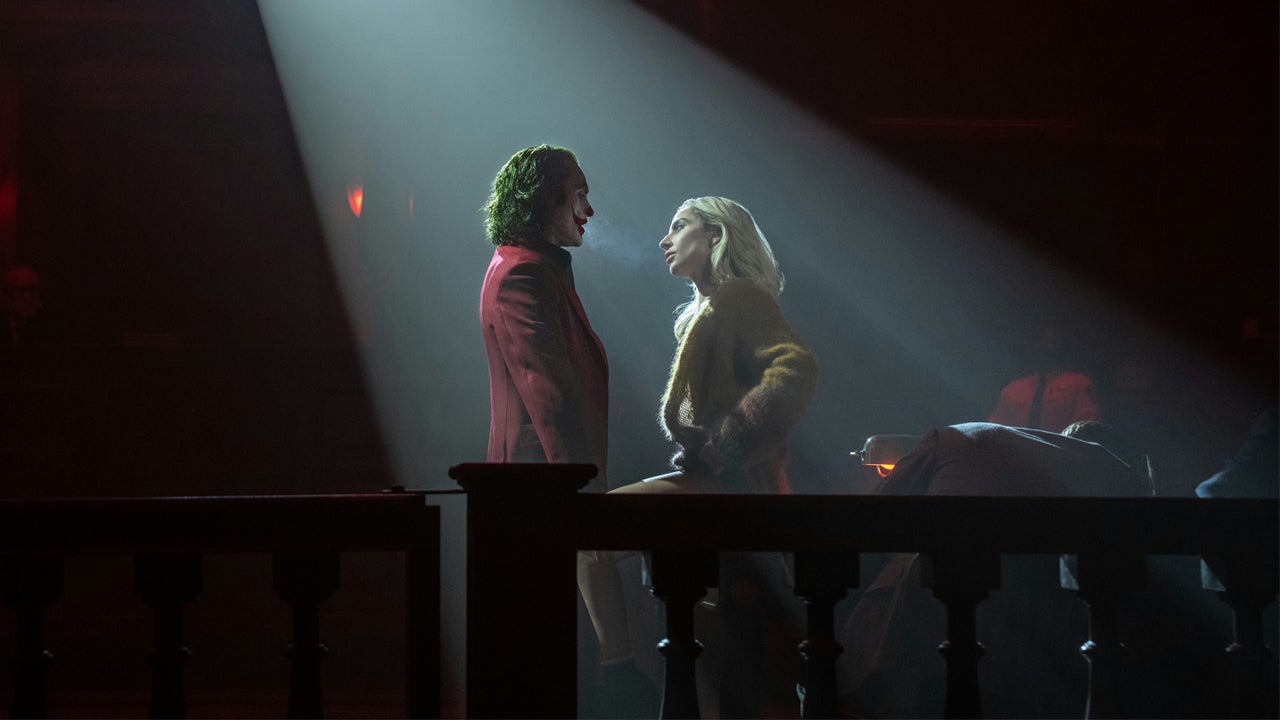
Missing the opportunity to use the animated sequence to step into an enhanced reality of the musical, we assumed that the introduction to Harley…sorry, ‘Lee’…would prompt the switch to a musical, perhaps as a representation of her worldview of their shared madness. Where this idea stumbles is in the lack of consistency in how the musical numbers are applied. There’s a few ways to do this – you could go with the classic ‘heightened reality’ wherein the diegesis of the narrative allow characters to express themselves through song and dance, you could use fantasy musical numbers to represent the character’s fractured perspective, or if the narrative allows the characters could be singing out loud and heard by the other characters around them. Joker: Folie à Deux takes the bold strategy of…all of them applied randomly.
This makes for a confusing experience. The first ‘musical number’ is Arthur (Phoenix) singing in the prison TV room before we snap back to reality and see that he hasn’t moved from the TV, so it was a heightened reality. We assumed the same thing was happening when Lee (Gaga) broke out in song when they try escaping the asylum…but other characters commented on her singing during the break-out? So maybe she sings and he’s caught up in her world. The bigger musical numbers, with costumes and colourful settings and whatnot, all took place while Arthur was sleeping, so that was his imagination…except sometimes it’s while he’s awake. It feels like Phillips decided this would be a musical without putting much work into finding out what makes a musical work, or how it narratively functions, or without any plan beyond ‘make it look like a musical number’. What should have one of the biggest selling points wound up feeling like it was padding out the runtime.
Another big selling point was the inclusion of Harley Quinn, an animated side-kick to Joker who’s popularity saw her make the jump to the comics, video games and live-action movies. Her growth from a henchmen to a well developed and realised character makes her a unique star in the world of comic characters, and a fresh take is always welcome. Unfortunately, Lee Quinzel is sadly lacking in character development. For a character driven film, there’s little depth to the Joker’s new co-star. She’s obsessed with Joker from before we meet her and we learn that she orchestrated the chance to meet him. It’s never confirmed what about her is true or not, so we never get to know her. Initially she becomes a public figure in the Joker’s trail, bringing some real Majorie Taylor Greene energy to her sycophantic obsession, but for a good chunk of the second half of the film she sits in the background waiting for them to find her a scene to be in. The way this plot thread wraps up is shockingly brief and feels like a hasty footnote.

The name up in lights is, of course, Joker. After a massive hit with the previous film, we had set things up to explore the character as a public figure, being drawn into another crazy person’s world, getting manipulated by the powers that be. We don’t really get that, however, as Arthur Fleck begins the movie as the Joker and by the end of the movie he’s still the Joker with little happening in between. In the first scenes he’s not smiling and seems to have given up on life, but then the guards mention that he’s been smiling every day except for today. This isn’t explored or even tells us anything, and makes it feel like they forgot to write in any connective tissue between the films. Arthur doesn’t have any agency in his story, with a random nicety from the guards bringing him together with Lee, her machinations that allow them to spend time together (perhaps this speaks to her being manipulative but we don’t see it), nothing he does ever drives the plot. Even his final revelation to the courts during his trail is prompted by…being raped by the prison guards who had liked him until he said one mean thing? I think that’s what was implied, and if correct that’s a really weird and unpleasant way to take the film.
Ambiguity is a big feature of this film, and it certainly not intentional. Many film-makers forget that they need to ‘show, not tell’ in a visual medium, but Phillips goes one further with ‘tell them one thing, but show something else’. Here’s one example – Arthur takes a cup of pills in the prison and then his mouth is checked to make sure he swallowed them. We get reminded of this when he does it again later in the film, complete with a clear shot of his mouth being checked. In the next scene, he tells Lee that he has stopped taking his medication. We have just seen that he has taken his pills…but he’s telling us he hasn’t…is he lying? I can’t work out what the intent was with this moment, and it’s not alone in the film.
Before we get into the end of the film, which will be spoilt below because we have thoughts, we do want to highlight what worked in the film. Phoenix is still putting in an amazing performance, even if they mostly just ask him to bend backwards while furiously smoking. He manages the musical numbers with Joker’s rasping voice as well as expected. Gaga is a musical performance legend and brings her skills and experience to the fore. We also love seeing Gleeson and Keener is anything, but their characters have such wildly inconsistent characters that it’s difficult to enjoy their presence. Does Gleeson’s Irish guard have a soft spot for Arthur, or does he enjoy putting him down? It almost feels like a different person scene to scene.

Now, what happens at the end. Arthur is abused by guards and this prompts him to take responsibility for his murders in court. This admission that he’s ‘not Joker’ is enough for Lee to storm out. Then, completely out of Arthur’s control, someone bombs the courtroom and he escapes. He meets Lee, and she says she doesn’t like him if he’s not Joker and leaves. Then he gets arrested, put back in jail, then some background character who has been giving him the stinkeye throughout the film stabs him to death. It’s a weak ending to the romance, hand-waving it away after it ran its course. Who was Lee, and what happens to her next? Doesn’t matter. Then a random fan (maybe?) kills Arthur. This might have had a bit more impact if Lee killed him for not living up to her expectations, but it’s just some guy. Then maybe he’s the Joker? This didn’t work in Halloween Ends either.
It feels like there is a strong hesitancy from the film-makers to do anything that will challenge expectations. This movie looks exactly like the previous film, which ignores the fact they now want it to be a musical with bombastic musical numbers. The murky, dirty colours of the original could be used to this end, but they don’t want to move away from the ‘bend backwards while smoking in a beam of grimy light’ formula. When you look at how well X and Pearl switched from a Texas Chainsaw Massacre style to a Wizard of Oz aesthetic while making them part of a cohesive series.
This is let down by being a rushed attempt to continue the success of the first film using a script that needs more time being ironed out. Lee turns up, doesn’t develop as a character and leaves. Joker doesn’t change or even drive the story. The story happens to him. Lee breaks in to meet him. The guard (who hates him?) randomly allows Arthur to join the choir where he can spend time with Lee. Lee sets things in motion for him to break out of the asylum. When Arthur’s big finale comes, involving him breaking out of the courtroom, it’s at the whims of a couple of Joker devotees who never even get named. It’s a character study without characters.

If the musical aspects were better or more imaginative, we could have enjoyed this more. As noted before they’re very awkwardly included into the film and little thought was given to the song choices. A couple of classic love ballads and then every result that came up when they googled ‘songs that reference clowns’.
Flat, pointless and one of the weakest endings we’ve seen in a long time. A wasted opportunity to do something interesting. Full credit to the key performers for working so hard on this, but the script and story is not here to support them.
Rating: SEVEN out of TEN


![Top 10 Creepy Cryptids [by Bea Harper]](https://i0.wp.com/houseofgeekery.com/wp-content/uploads/2016/10/cryptid.jpg?fit=1200%2C675&ssl=1&resize=40%2C40)


