Movie Review: ‘Killers of the Flower Moon’

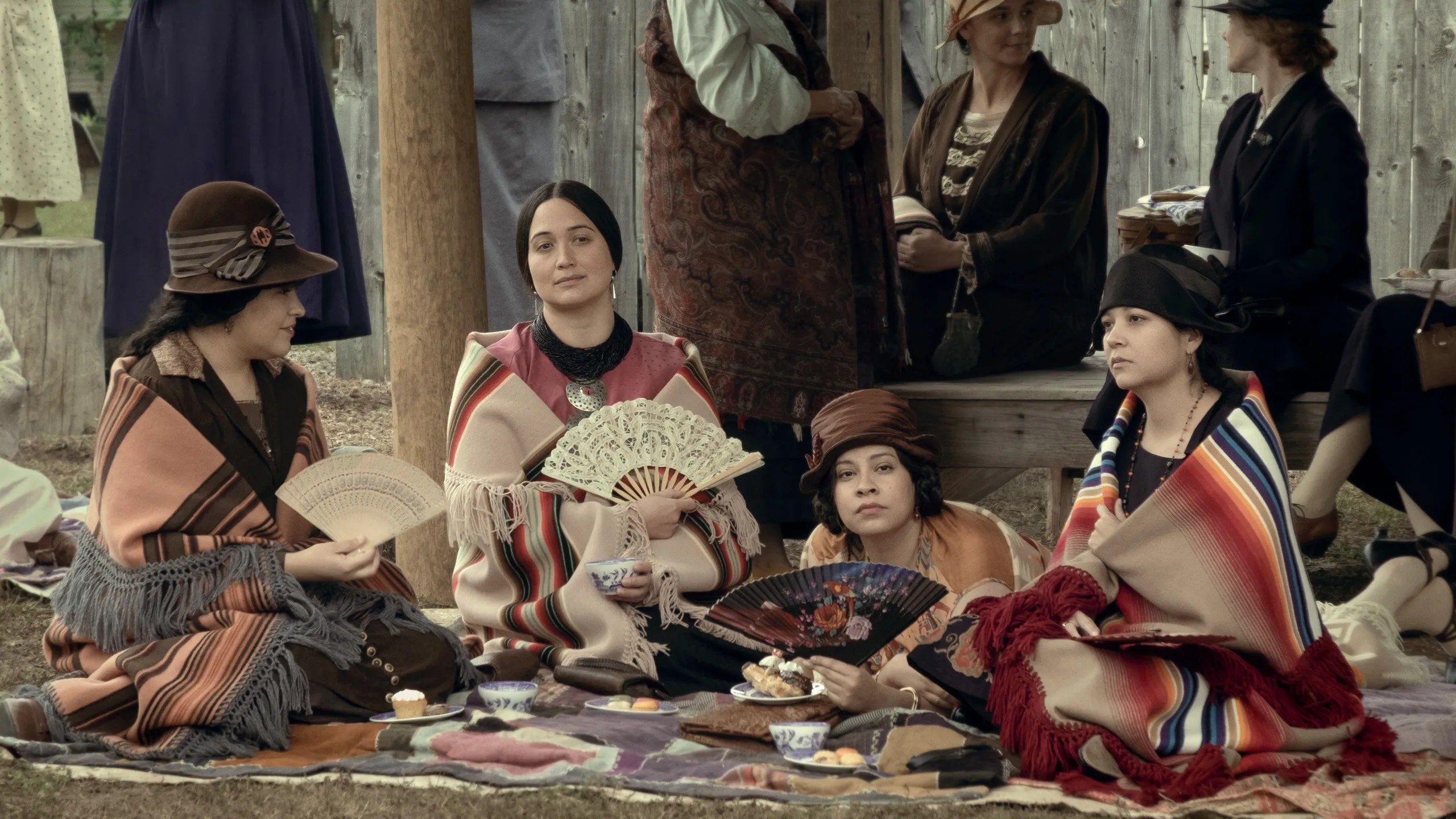
Plot: Based on the 2017 David Grann book of the same name, iconic director Martin Scorsese’s Killers of the Flower Moon recounts the tragedy of the Osage Nation of Oklahoma in the 1920s. After discovering oil on their land and becoming wealthy almost overnight, a series of gruesome murders draws the attention of the Bureau of Investigation (a precursor to the FBI). The story centers around the relationship between Ernest Burkhart (Leonardo DiCaprio) and his Osage wife Mollie (Lily Gladstone). Although seemingly devoted to Mollie and their children, Ernest lives a double life as the catspaw of his uncle William King Hale (Robert De Niro). A local wealthy political boss, Hale spends years ingratiating himself with the Osage people and pretending to be their friend while secretly scheming to take their wealth through duplicity and murder.
Review:
“Can you see the wolves in this picture?”
In 1978, Martin Scorsese’s personal life was in shambles. Despite achieving success with films like Alice Doesn’t Live Here Anymore, Mean Streets, and Taxi Driver and being one of the leading voices in 1970s cinema, he was severely depressed and addicted to cocaine. Shortly after filming New York, New York he collapsed and almost died. Scorsese spent ten days in the hospital and was down to an incredible 110 pounds. While I am profoundly thankful that the man turned his life around, I also shudder at the loss to the cinema world had he perished that day. No Raging Bull, no Casino, no The Aviator, no The Departed, no Silence, no The Wolf of Wall Street.
No Killers of the Flower Moon.
Imagine. Just IMAGINE.
In recent months, Mr. Scorsese hasn’t equivocated about his own mortality. At eighty Marty recognizes that there are more films behind than there are ahead. Although he’s given no indication he plans to retire, audiences (myself included) recognize that each subsequent Scorsese feature could be his last. It’s slightly morbid to think about but it also behooves one to savor every cinematic gem even more. If Killers of the Flower Moon (his tenth collaboration with Robert De Niro and his sixth with Leonardo DiCaprio) is in fact Marty’s swan song, it’s one Hell of a film to go out on.

Riveting, horrific, enthralling, profound, nuanced, and utterly captivating, Killers of the Flower Moon is a masterclass and masterpiece from a director at the zenith of his filmmaking abilities. From the opening frames depicting the Osage elders burying a ceremonial pipe and mourning the assimilation of their descendants into white American society, Killers of the Flower Moon casts a dark magic that keeps you spellbound for three hours and twenty-six minutes. Some will balk at the long runtime (and already have), and I’d be lying if I said I didn’t feel it…but not in the way you might presume. This wasn’t an “Oh my God when is this movie going to end” situation. Rather, when the film concluded I felt utterly empty and exhausted in the best way possible. Killers of the Flower Moon is quite actually the heaviest movie I’ve seen since Steven Spielberg’s Schindler’s List.
Since Killers of the Flower Moon debuted at Cannes in May, people have criticized Scorsese for not making an Osage movie, that KOTFM did not have enough of an Osage perspective. I won’t address the ever-growing reductive and juvenile critique of “I expected the movie to do X and it didn’t do X and that’s bad” (that’s an article for another day), I will only say that Martin Scorsese didn’t make an Osage movie. He never meant to make an Osage movie. In fact, I daresay only a member of the Osage tribe could make a film that would do their people justice. Rather Marty made a movie for the wolves.
KOTFM parades the sly snakes and savage coyotes that come with smiles. It demonstrates the willingness over and over again to otherize and treat the Osage as sub-human. For example, many didn’t have control over their own money because they were “incompetent” and required transactional authority from white bankers. There’s even a scene where a criminal is reluctant to commit a murder until he’s told “It’s an Indian.” Killers of the Flower Moon is a movie that forces you to address and grapple with the complicated, complex, and often horrific history the United States has with indigenous peoples. There’s no avoiding the empirical fact that we murdered countless Native Americans and stole their land. We still benefit from those atrocities. The tragedy of the Osage is just a microcosm of that. Scorsese’s movie rubs your nose in the tragedy for almost three and a half hours. You are unable to look away and that’s the whole freaking point. It compels you to ask the questions, “How have we been complicit? Will we continue to be complicit? Can we reconcile the past and do better going forward?”

From a technical perspective, Killers of the Flower Moon is flawless. I firmly believe that like calls to like, and talent attracts talent like a black hole absorbing light. The same is true here as Martin Scorsese surrounds himself with the best in the business. Cinematographer Rodrigo Prieto delivers arguably the best work of his career with his depiction of the beauty of Osage ceremonies in stark contrast to some of the savage murders in the film. There’s a reliance on two-shots and several upward-angle shots that make some of the devastating close-ups all the more impactful. The camerawork resonates with Marty’s themes, especially the final one. Robbie Robertson provides an elegiac and haunting score that’s likely to garner him a posthumous Oscar nomination. Editor Thelma Schoonmaker (who’s collaborated with Scorsese for almost sixty years and worked on every one of his movies since 1980’s Raging Bull) proves once again why she is the G.O.A.T. Her artistic genius elevates Killers of the Flower Moon into high art. Additionally, the production and costume design is nothing short of wondrous. There’s such attention to detail and authenticity that you feel transported into 1920s Oklahoma. Eric Roth and Scorsese’s screenplay also dazzles, weaving a powerful and absorbing tale that’s lavish, punctuated with gripping dialogue, and savage in its depictions.
Hard to believe I’ve come this far without even mentioning the acting performances, but that just goes to show you how phenomenal this movie is. Regardless, the acting in Killers of the Flower Moon will leave you gobsmacked. De Niro delivers his best work since Cape Fear with his morally bankrupt William Hale almost too evil to contemplate. Hale’s a man who commands respect, a serpent that weaved his way into the Osage community while treating that area of Oklahoma like his own personal fiefdom. He’s a crime boss who will enchant you with smiles and assurances before his henchmen stab you in the back. What De Niro does with a carefully inflected tone of voice, a harrowing stare, or a devious smile, reminds you he’s one of our greatest living actors and when fully invested, the results can be tremendous.
I say this next with no hyperbole—this is the best performance of Leonardo DiCaprio’s career. His role as Ernest Burkhart left me stupefied. You’ve never seen DiCaprio like this. Typically, we associate DiCaprio with virility, dynamism, and beauty. Not so here. His Ernest is weak, stupid, and easily manipulated. There’s a vulnerability and complexity to his character that I wasn’t expecting. It evokes sympathy but not empathy. This is a man who seemingly loved his wife yet was all the while poisoning her. DiCaprio’s performance makes you wrestle with the question of if Ernest actually loved Mollie. If a loving relationship has any element of abuse, can it really be called love? DiCaprio’s chemistry with De Niro is everything you expect it to be with a meeting at a Mason’s Lodge and a scene between Hale and Ernest in jail being particularly memorable. There’s also a moment when Ernest finds out about the death of one of his children that is absolutely devastating. If you asked me a month ago, I’d have said Cillian Murphy had the Best Actor Oscar locked up, but the man has some serious competition now.
Despite the titanic performances of De Niro and DiCaprio, Killers of the Flower Moon simply does not work without the gut-wrenching performance of newcomer Lily Gladstone as Mollie Burkhart. I cannot sing her praises enough. She is the beating heart and soul of this movie. The one we most empathize with. The one we want to protect. Mollie’s abuse is a microcosm of the abuse suffered by the Osage people and as the audience we desperately want her to extricate herself from the situation. Gladstone’s performance isn’t flashy, but subtle and stoic. What Gladstone can convey with a look, a shrug, a sigh, or a slight tilt of the head carries the weight of a thousand suns. It makes the few moments where she emotionally breaks down all the more impactful. Gladstone also possesses dynamite chemistry with DiCaprio as she stands toe-to-toe with one of this era’s finest actors in every frame. Mollie’s final scene with Ernest after a trial late in the movie was pure perfection.

Killers of the Flower Moon also showcases a plethora of minor performances. Jesse Plemons delivers the equivalent of an MLB closer, coming in at the last minute with a solid turn as BOI agent Tom White. Veteran actor Tantoo Cardinal enchants as Mollie’s mother Lizzie. Even musicians Jack White and Pete Yorn show up in small roles. Scorsese also made a concerted effort to include the Osage people in this production with over three hundred participating including fifty speaking roles. Talee Red Corn as Non-Hon-Zhin-Ga and Yancey Red Corn as Chief Bonnicastle were particularly memorable.
One thing to note. You may have heard about the, shall we say, unique acting choices of Brendan Fraser in this film as Hale’s attorney W.S. Hamilton. Fraser’s performance in the courtroom is decidedly hammy and overdramatic and initially turned me off. However, the more I think about it, the more I believe that was by design. There’s no way Fraser delivers that performance without Marty’s approval. Now whether or not that was the right call I leave up to the viewer.

Speaking of Scorsese, how he chooses to end this film completely subverts expectations. In movies like KOTFM, you expect the inevitable text on the screen that describes what happened to the main characters. Instead, we get a radio broadcast production that serves as a social commentary on true crime podcasts and as a chef’s kiss ending. Indeed, Marty himself (credited as Radio Show Producer) speaks the final lines of dialogue in this film. Words that quite honestly had me choking up at their simplicity and impact.
I can’t laud Killers of the Flower Moon enough. It’s not only one of the best films of the year it is one of the best of Martin Scorsese’s career.
1 God Awful Blind Yourself With Acid Bad
2 Straight Garbage
3 Bad
4 Sub Par
5 Average
6 Ok
7 Good
8 Great
9 Excellent
10 A Must See
Killers of the Flower Moon: 10/10


![Top 10 Creepy Cryptids [by Bea Harper]](https://i0.wp.com/houseofgeekery.com/wp-content/uploads/2016/10/cryptid.jpg?fit=1200%2C675&ssl=1&resize=40%2C40)


