Movie Review: The Long Walk

Plot: In an alternate, dystopian version of America ruled by a totalitarian regime, the United States has been financially devastated. In order to invigorate economic production, once a year 50 teenagers compete in a brutally violent televised event called The Long Walk. If you fall below a speed of three miles per hour more than three times you are shot and killed. The victor earns untold riches and a wish. Fueled by hateful motivations towards the military dictator The Major (Mark Hamill), contestant Ray Garraty (Cooper Hoffman) enters the contest determined to win. Yet along the way he unexpectedly gains a myriad of friends including Arthur (Tut Nyuot), Hank (Ben Wang), and Pete (David Jonsson). But can Ray or any of his new found friends retain their humanity in a contest where there’s only one winner and no finish line? In the end the truth is simple: walk or die.
Review: Fans of Stephen King are eating in 2025. Actually with four films, two television series, an anthology of short stories, and a novel by the man himself, it’s probably more appropriate to say we are feasting. However, as prolific and well known as Stephen King is, most are unfamiliar with the first novel he ever wrote. King first penned The Long Walk as a freshman in college in response to the Vietnam War. However, it wasn’t published until the late 1970s under the pseudonym of Richard Bachman. Several attempts to adapt the novel have been made over the decades. At one point the rights were in the hands of notable filmmakers like George A. Romero (Night of the Living Dead) and Frank Darabont (The Shawshank Redemption). Yet, in the same way Orson Welles quipped that no wine should be served before its time, certain book adaptations don’t crystalize until the appropriate creatives get their hands on them.
Such is the case with director Francis Lawrence and writer J.T. Mollner’s The Long Walk.

Stark, timely, harrowing, and heartbreaking, The Long Walk is not only one of the best Stephen King adaptations ever made, it’s one of the best films of 2025.
One of the inherent concerns of adapting a work by a beloved author is motivation. King’s works have certainly fallen prey to studios looking to make a quick buck off the writer’s name with disastrous results. (Night Shift anyone?) Thankfully, both Mollner and Lawrence are clearly fans of King’s novel. Despite a few narrative changes, both do an admiral job adhering to the spirit of the book. Mollner’s dialogue captures the banter and camraderie of teenage boys to a startling degree. Meanwhile Lawrence feels tailor made for this production with The Long Walk essentially a perfect marriage of The Hunger Games and Stand By Me.
Rather than update the novel to modern times, Lawrence chooses rightly to keep the 1970s aesthetic whether that’s car models or clothing and hair styles. Consequently, you’re transported to a dystopian, alternate America whose motifs and mood echo current events and rhetoric. This not only enhances your suspension of disbelief but resonates on a level that other aesthetic choices would not. Lawrence paints a picture of a distorted Americana landscape replete with burning cars, dead animals, and desperate, forlorn onlookers. Everything possesses a yellow, washed out quality enhanced by Jo Willems striking cinematography. The effect showcases a worn down, exhausted America that seems to be rotting from within. While the kills are graphically violent, they never come off gratuitous. (However, I will admit the violence did suffer a bit from being noticeably computer generated at times.) Despite all the violent imagery I’ve seen in films over the years, the brutality in The Long Walk made me squirm and want to look away. This portrays a stark and grim world as only director Francis Lawrence could. It’s balanced out by a haunting yet subtle score from Jeremiah Fraites that kicks in only when necessary. Indeed The Long Walk‘s score could have been completely excised and the movie would have been just as effective.

Yet despite all the aesthetic, cinematic, and narrative choices by Lawrence and Mollner, The Long Walk would be fruitless and impotent without a stunning cast. There’s no doubt in my mind that casting director Rich Delia should be nominated in the inaugural casting Oscar next year. Every actor in The Long Walk brings the heat. Ben Wang shines as the sarcastic and hilarious Hank Olson who brings to mind Corey Feldman’s Teddy from Stand By Me. In fact there’s a conversation Hank engages in that’s reminiscent of the Superman/Mighty Mouse debate from that same movie. Hank’s charm makes his ultimate fate that much more gut wrenching. Tut Nyuot also makes for an affable Arthur, coming across like a loveable if occasionally naive cousin. Meanwhile Charlie Plummer’s Gary Barkovitch completely embodies the character from the novel. He’s a character you love to hate especially after a particularly cold and calculated action. Yet his ultimate story arc evokes an empathy I wasn’t expecting. Of the group, only Garrett Wareing’s Billy Stebbins gets short shrift, surprising considering the character’s significant role in the book.
Mark Hamill also plays against type as the cruel, brutal, and authoritarian The Major. Much like Boss Godfrey in Cool Hand Luke, The Major never takes his sunglasses off, even at night. Hamill walks the tightrope between evil bastard and cartoonish caricature. It sometimes veers into over-the-top territory, but in some ways I think that’s by design. His constant inane ramblings are fodder for one of the funnier moments in the film. (Side note: it’s important to point out that as stark and brutal as The Long Walk can be there are moments of levity.) Judy Greer also brings a suitably tragic desperation as Ray’s mother Ginnie, despite being limited to only a few scenes.
However, it is the chemistry between Cooper Hoffman’s Ray and David Jonsson’s Pete that makes The Long Walk soar. As the film progresses their relationship deepens from budding friendship into true brotherhood. Their conversations evolve from the superficial and profane to deeply personal and philosophical. Both Pete and Ray have their own motivations for participating in the Long Walk that speak to the deeper systemic problems of the society at large. In a world bereft of empathy and steeped in fascism, is it even possible to find a way out? Hoffman proves once again he’s got the acting chops and isn’t just a nepo baby. There’s a poignant moment where Ray discusses his father’s fate, where I couldn’t help but think about Cooper’s own father, Philip Seymour Hoffman, who died of a drug overdose ten years ago. Yet as great as Hoffman is, Jonsson gives a truly transcendent, Oscar worthy performance. Jonsson’s character of Pete possesses inherent goodness, optimism, empathy, and tenacity that you want to nurture and protect. With Alien: Romulus and now The Long Walk, I can’t wait to see where Jonsson’s career takes him next.
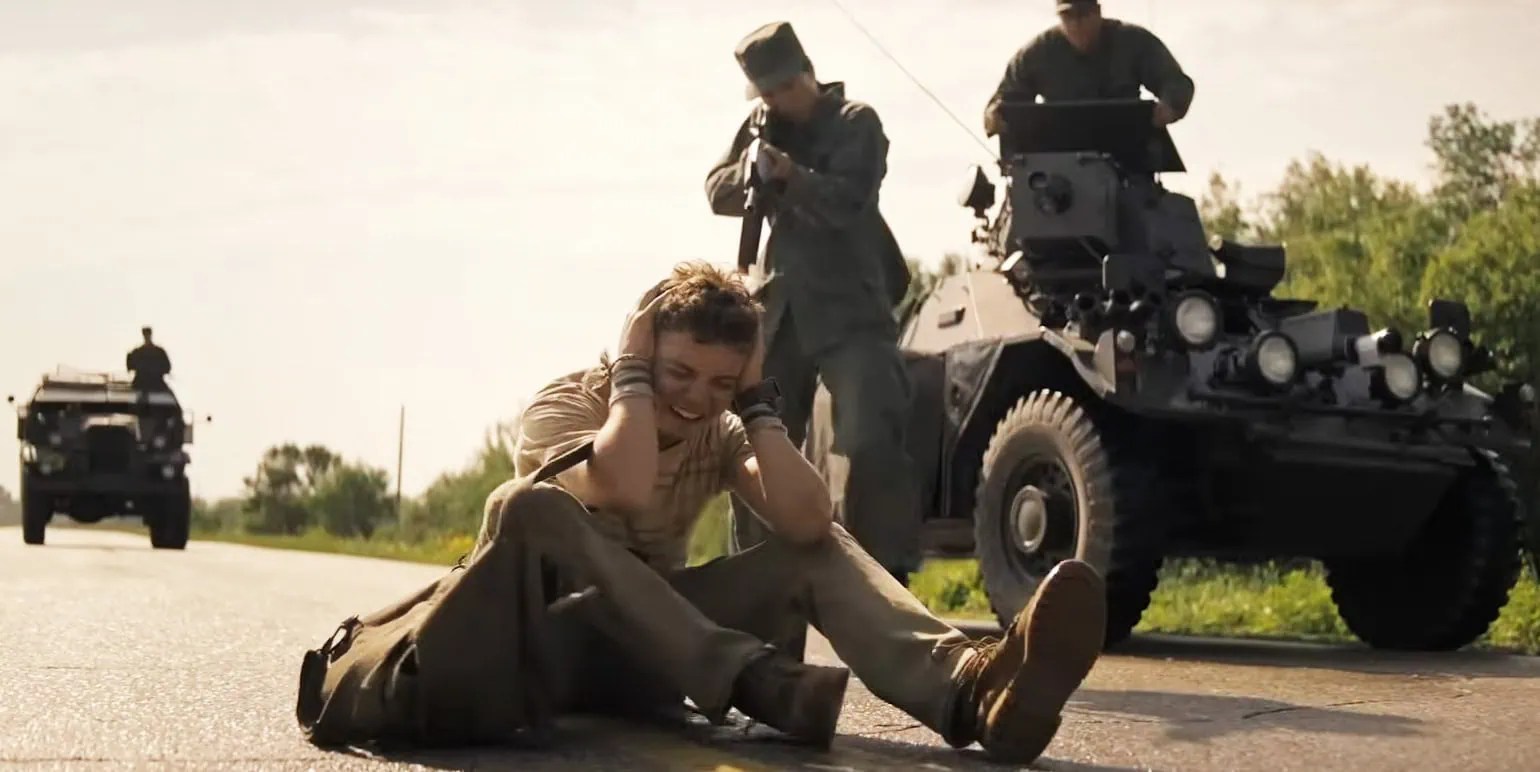
In addition to the stupendous performances and excellent cinematic decisions in The Long Walk, I would be remiss if I didn’t mention the film’s themes. This is a heavy movie. There’s clear social commentary on the encroaching fascism that’s pervading America and to a greater or lesser degree other countries globally. The Long Walk also examines our obsession with shocking spectacle as a way to escape. It’s also clearly an anti-war film with the participants of the Long Walk just fodder for the financially profitable war machine, with the contest seemingly the only viable escape from economic despair. Furthermore, I find it ironic that in the same week a horrific act of political violence occurs in the United States, a movie involving several acts of political violence releases. Violence ultimately just perpetuates more violence and as Pete says in a poignant discussion with Ray, it’s got to be about more than revenge or nothing will ever change. Yet what recourse is left to you when historically fascists never leave power voluntarily? These are deep questions, that The Long Walk offers no easy answers to.
A final note for fans of the novel. The ending of The Long Walk makes a significant change from the novel, one that I appreciated but that not all people may enjoy. In fact with distance and further reflection I’m starting to question if the ending audiences saw actually happened at all. I have my own conclusions but any discussion would ruin the film’s ending and I’m not a monster.
Ultimately, The Long Walk proves to be a harrowing, dynamic, and riveting watch that’s impossible to ignore. I highly recommend you sign up for the trip, just be forewarned that the hike will be far from comfortable.
That’s the point.
My rating system:
1 God Awful Blind Yourself With Acid Bad
2 Straight Garbage
3 Bad
4 Sub Par
5 Average
6 Ok
7 Good
8 Great
9 Excellent
10 A Must See
Masterpiece
The Long Walk: 9/10


![Top 10 Creepy Cryptids [by Bea Harper]](https://i0.wp.com/houseofgeekery.com/wp-content/uploads/2016/10/cryptid.jpg?fit=1200%2C675&ssl=1&resize=40%2C40)


