Top 10 Titles from DC’s Reboot – One Year Later
So, last July, DC Comics revealed that they would be cancelling their entire line and starting every book from issue 1. For years now, the number 52 has played a huge part in DC Comics. It was first the title of a weekly maxiseries that filled in a missing year between Infinite Crisis and their line-up of titles that jumped forward one year. By the end of that book, it would come to mean the 52 alternate Earths that existed in DC canon. Now, it refers to the number of on-going comics that DC is publishing (not including miniseries and one-shots). These 52 books debuted last September. Some of them have lasted, some of them haven’t, but each time one was cancelled there was a new one to take its place to keep that 52 consistent. Now it is August, and the books that have lasted from the beginning will be publishing their 12th issue this month. That’s a full year of comics. While it was fun to give our first impressions when each of them debuted last year, we can now judge them on a much better scale. So here is what I consider the best books currently being published by DC Comics.

10. Batwoman
Batwoman is a very new character making her first appearance in 2006 during the weekly year-long series, 52. As her story goes, we learn she was a military brat who was discharged from the army for being a lesbian. She spent the rest of her time as a party girl heiress until an encounter with Batman inspired her to action. She has mixed in and out of comics for a while including taking lead on Detective Comics, teaming up with her ex-girlfriend Renee Montoya to take down the followers of The Crime Bible, and joining a proactive Justice League team led by Hal Jordan and Oliver Queen. Her new series was meant to start in February 2011 but kept getting delayed. It seemed as if it was ultimately held for the reboot, so not much has really changed to the story and character if it had premiered previously. The new book features some of the best art currently in the industry. It makes works of art out of splash pages, and the artists creatively work words and panel outlines into the art instead of leaving it as filler or template. Batwoman’s stories also remind me of modernized version Batman’s Black Casebook when he was fighting more surreal mutants and monsters.

9. Green Lantern
Since 2004, Geoff Johns has been associated with Green Lantern rebuilding everything that was shattered in Green Lantern canon that left Kyle Rayner as the lone GL. Original Silver Age GL, Hal Jordan returns to the center stage of the Green Lantern book while backed up by John, Guy, and Kyle (all of his Earth-bound alternates) who have been made honorary Green Lanterns. Johns started building a mythology around the details of the Green Lantern power, specifically the emotional spectrum where Green/Will represented the center point of many other colors, all of which started building their own corps. The lynchpin to Johns success was his retelling of Hal’s Secret Origin (which should definitely be checked out). It took many different elements from all the variations, streamlined them into one story, and set the ground work for continuing long arc stories and prophecies. Not much has changed in Green Lantern since the reboot. It really is just business as usual, but that doesn’t make it any less exciting or fun. It still has been the most consistent book for years.

8. Justice League Dark
In 2010, it was announced that the Vertigo imprint of DC would be strictly creator owned, and that any characters who originated in the DC universe would return and stay in DC canon (with the exception of Hellblazer). This included characters like Swamp Thing, Black Orchid, and Madam Xanadu, all of who had great runs with much darker stories. With them all returning to the DC universe, there was a feeling that maybe the dark stories wouldn’t come with them. Justice League Dark is the answer to that written by the fantastic Jeff Lemire, who also writes the amazing Animal Man. In his own words, he goes about writing the characters as if they were pulpy detective characters who are disturbed by things they can’t unsee. They came together to defeat Enchantress after she had taken out the Justice League and then went on to team up with I, Vampire’s Andrew Bennet and Justice League’s Steve Trevor. Lemire effectively captures some of the disturbing, gothic imagery of Animal Man but with a more classic superhero team-up feel rather than Animal Man’s superhero subversion.

7. I, Vampire
I remember reading the solicitation back when they were revealing the reboot piece by piece, and I thought to myself, “DC is just trying to cash in on the Twilight craze.” The cover art that followed didn’t do that assumption any favors as it featured 2 emo looking adolescents looking all mopey together. What I wasn’t expecting was that the book would end up being one of the best books DC was putting out a year later, nor did I think it would have more in common with Dracula and Near Dark and give a big old middle finger to the Twilight series. The story itself is actually a retelling of an ‘80s House of Mystery story that involved a repentant vampire named Lord Andrew Bennett who was trying to protect the modern world from his jilted ex-girlfriend, who was jilted because of the whole vampire thing. The basic premise is still the same except it seems like Andrew and Mary haven’t been around for a while and are rather products of the modern time. I feel a little bad because I don’t know who Joshua Hale Fialkov is outside of his writing duties on this title, but I feel compelled to seek out some of his older work now. My favorite part of the book was when they revealed the first vampire (or at least a powerful vampire) to be named Cain. It seemed like it was implied that it was Cain of the Biblical Cain and Abel, who is also considered the first murderer. It reminds me of the many different historical revisions made in horror movies. Sort of like Abraham Lincoln slaying vampires, but more like the tv series Supernatural that referred to Eve as the Mother of All Monsters.

6. Batman Incorporated
Batman, Incorporated is the brain child of Grant Morrison who has been writing Batman for a while now. He has literally taken Batman through life, death, time, and back to life again. Once Bruce was able to reestablish himself as Batman, he has an epiphany to use the symbol of the bat on a global scale. He works tirelessly to recruit international vigilantes to help bring world peace. Morrison excels at investing long-arc storytelling and multi-layered themes and symbols, but he deftly hid those elements within the fast paced, pulpy feel that each issue had. The reboot threatened to take out Morrison’s run on Batman before he came to a sense of closure. Almost a year later, the series was thankfully restarted. It may only be 3 issues in, but it is the culmination of so many plotlines and themes of Morrison’s stories. It looks like a closure point is now in sight as the reason for Batman Inc is finally revealed. Batman had an apocalyptic vision while returning from the dead which is directly connected to the shadowy organization, Leviathan. Leviathan proves capable of brain washing mass numbers of people and creating their own superhuman soldiers. Worst of all, the organization seems to have it out for Damien, Batman’s biological son and current Robin.
5. Aquaman
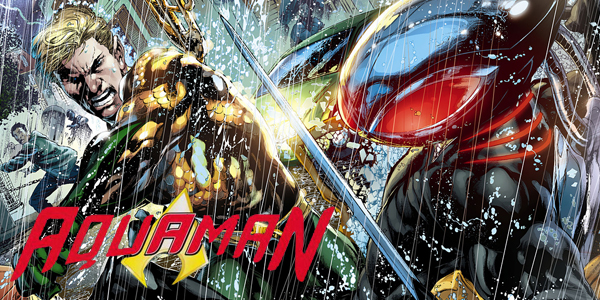
Aquaman is another of the superheroes created in the 40s at the onset of the superhero trend in comic books (That’s right, kids, at one point comic books had all kinds of genres, still do!). He is half-human and half-Atlantean granting him amphibious powers including the ability to psychically control marine life and granting him super strength and speed while on land (since his body is adapted to life in cold ocean pressure). Thanks to his Super Friends participation, he has become a joke to anyone who hasn’t cracked a comic book since the 70s or 80s. Thankfully, in the 90s Modern Age of superheroes, he was revisited with a more dramatic slant focusing on his split loyalty to the land and the sea as well as the pressures of his role as King of Atlantis. And then there were the waterbearer stories, which were my personal favorites. They reached back into Arthurian legend and used the Lady in the Lake to move Aquaman forward as far as scope and overall mythos, but that was quickly changed. Since even before the DC 52 reboot, Geoff Johns has been trying to revitalize Aquaman starting with Blackest Night, where Aquaman became a key player in the Blackest Night/Brightest Day prophecy. Now Johns has returned to the character again. He put him back in his classic uniform, revisited the pressure of his loyalties and role as king, and started expanding on the Aqua-scope and mythos much in the same way that Johns molded the Green Lantern series into the juggernaut that it is now. Johns has since introduced a group of heroes Aquaman used to journey with, casually called The Others, and has begun investigating the how and why Atlantis sunk.
4. Swamp Thing
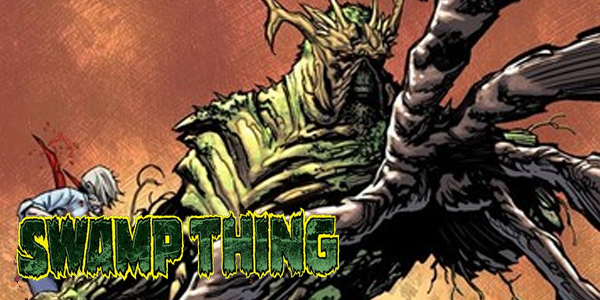
Swamp Thing is one of the classic examples of comic book creations. He only first appeared in the ‘70s, but thanks to a mildly successful live action career in film and television as well as a classic Mr. Hyde pulp fiction feel, Swamp Thing feels a bit timeless. His original origin story involved a scientist by the name of Alex Olsen (later Alex Holland) who survives a lab explosion severely mutated into a plant monster. This was later updated by Alan Moore, who ended up making Swamp Thing a plant that turns into a plant-man rather than a man who turns into one. He also implied that there have been many Swamp Things as agents of the Parliament of Trees, otherwise known as The Green. It is this concept of The Green that Batman writer Scott Snyder uses to connect Swamp Thing to Animal Man. Where Animal Man is connected to The Red/Fauna, Swamp Thing is connected to The Green/Flora, and together they stand in the way of The Rot. While Swamp Thing is a fantastic piece of horror superheroism all on its own, the constant connection to the Animal Man book sets the two of them apart from everything else going on in the comic industry. The highlight of this pair up is the mysterious new enemy, The Rot. The Rot has not yet been seen as an individual yet, but his agents have been attacking Buddy and Swampy on and off throughout their first 12 issues, with each passing issue feeling like they are just getting closer and closer to a face off. The story arc, “Rotworld,” is just around the corner and should make for some really awesome imagery and interesting storytelling.

3. Animal Man
Animal Man, aka Buddy Baker, was created in the 1960s and was about as interesting a character as his name would imply. He was a (insert cool occupation here) stuntman who was near a (insert sci-fi catalyst here) spaceship that gave him (insert vague power set based on uninspired name here) the ability to mimic animal abilities. Now, that is not to say that he wasn’t chock full of potential. In the 80s, Grant Morrison, who consistently reaches back to the annals of D-list heroes that DC has accumulated over their existence, refocused the story on Buddy being an everyman with a nuclear family to take care of. He peppered the stories with thoughts on animal rights and vegetarianism and obscure DC references. This more alternative story-telling style has characterized Animal Man stories ever since. His role as Animal Man has even taken on greater importance as he has become the avatar for The Red (a cosmic force tied directly to the fauna of Earth). Sweet Tooth writer Jeff Lemire has sent Buddy down a weird path with the reboot. As the avatar of The Red (or so he thinks), Animal Man is pitted against The Rot, a sinister forced bent on decaying all life. Lemire successfully blends horror with classic superhero fare. He does this not just through disturbing imagery (although he has that in spades), but he also builds great relationships between Buddy and his family making us care dearly about the fate of his supporting characters.
2. Batman
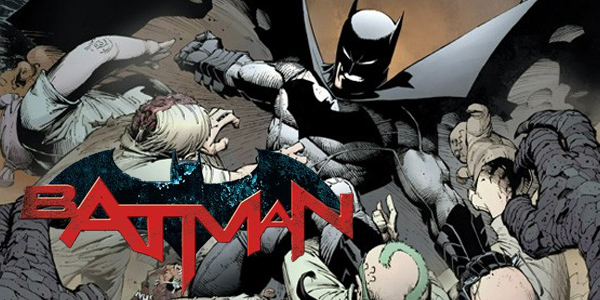
When Bruce Wayne’s parents are killed right in front of him, Bruce uses his inheritance to travel the world training his mind and body to combat the darkness that hides in the alleys and dark corners of his beloved hometown, Gotham City. By using his own fear of bats and his arsenal of non-lethal weapons, he strikes fear into the hearts of Gotham’s criminals. Scott Snyder, who created the award-winning, gothic historical horror, American Vampire (Seriously, do yourself a favor and read this), takes Batman on one of his toughest journeys yet. Through Batman’s long history, he has dealt with everything from classic gangster archetypes to a serious earthquake that almost shakes Gotham off the planet, and more recently, he was zapped by Darkseid and became unstuck in time. Snyder had to really up the ante from the gauntlet of Arkham refugees that he usually sweeps off the street, so he strikes at Batman’s ego. He pits Batman against a centuries old clandestine organization of peace keepers known as the Court of Owls. They are the subject of an old Gotham nursery rhyme sending their existence into mythology. Their numbers are filled with the revolving door of influential and affluent members of Gotham society and armed with an immortal army of assassins made up of cast-offs from Haley’s circus. As a unit, they psychologically torture Batman and Bruce Wayne trying to take back ownership of the city. It has become almost comical how easy it is for Batman to get himself out of any situation with the all-mighty power of “prep time.” To have his reality truly shattered puts Bats in a position that we haven’t seen him in in a long time. In fact, it is a kind of desperation that Christopher Nolan has been able to drive Bruce too.
1. Wonder Woman
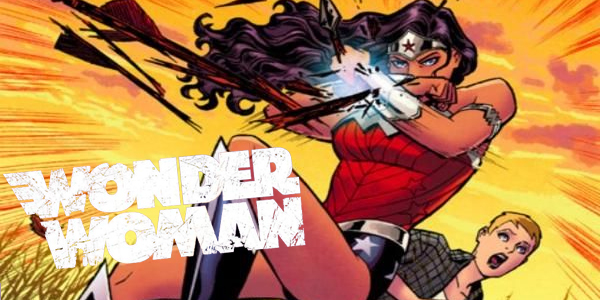
Wonder Woman, aka Diana Prince, is a warrior princess from Themyscira Island, home to the Amazons of Greek mythology. She was originally molded from clay by her mother (and queen of the Amazons) Hippolyta. Hippolyta’s prays are answered when the gods turn her clay figure into a flesh and blood baby. Diana is then raised under the Amazon tenets of love, peace, and sexual equality. She went out into “Man’s World” to represent these tenets and serve as some kind of savior. Armed with her Amazon armor and unbreakable Lasso of Truth, Wonder Woman went from fighting the Axis powers during World War II to fighting supervillains as a member of the Justice League. The DC reboot puts this Wonder Woman mythos on its head. The story, as we know it, is still considered true by Diana, but when a human woman carrying Zeus’ baby is marked for death, Diana gets a look behind the curtain of her benevolent society and sees the aggressive machinations that keep it going. Thanks to Brian Azzarello (of 100 Bullets fame), he added a level of personal strain to the Wonder Woman character, who is continuing forward as a representative of peace and love while struggling with her heritage’s dark secrets. The added horror elements work surprisingly well, invoking images from classic mythology instead of the fluffy revision we have been reading since the ‘40s. She is teamed up with a pretty cool supporting cast too including a world-weary Hermes and a cockney son of Zeus, Lennox, who has rock-like skin.


Batwoman is amazing, I’m so glad you have her on this list.
Aquaman and Animal Man deserve the love too.
Fabulous list!
LikeLike
Batman is arguably the best reboot out there, glad to see it so high!
LikeLike
Also big ups for including Aquaman, he’s clearly the biggest winner out of the entire reboot series and it’s well deserved
LikeLike