Movie Review: ‘The Social Reckoning’
Director: Aaron Sorkin
Cast: Mikey Madison, Jeremy Allen White, Jeremy Strong, Wunmi Mosaku, Bill Burr, Billy Magnussen, Betty Gilpin
Plot: Frances Haugen is a data engineer at Facebook who, upon seeing a friend radicalised by online content, connects with Wall Street Journal investigative reporter Jeremy Horwitz in an effort to expose the misdeeds of the social media giant.
Review: It’s not uncommon for The Social Network to crop up among discussions of movies that need a sequel. Sorkin and David Fincher’s original examination of Zuckerberg’s rise to power was the first look that much of the public had into the company that had become an integral part of our lives. Who Zuckerberg was as a person and the story behind the company was largely codified in the public consciousness by The Social Network. In the decade and a half since, Zuckerberg has become a household name, an easily recognised public figure, and the harm caused by the platform has grown exponentially. Online bullying and harassment, political and social division, the growth of hate and violent groups, and the spread of radicalised politics have all been linked directly to social media policies designed to promote profit through any means necessary. This has turned the discussion from social media being a fun diversion and successful business model to being a dangerous blight on our communities.
So, if there ever was a time for another movie to spotlight the devastating damage Facebook has caused in the past two decades of operation, specifically the fact that the people running the company are happy to continue causing harm in the name of profit and influence, it would be right now. The question that remains, however, is how do you condense such a huge and complex problem down to a two-hour script? Aaron Sorkin is undoubtedly the best man for the job; his punchy political scripts are second-to-none, but he’s stepping into the director’s chair, and David Fincher has enormous boots to fill.
The Social Reckoning puts the focus on the individuals who have tried to bring Facebook’s despicable policies into the light in recent years. Frances Haugen (Madison) is a data engineer who is committed to the mission statement of the social media giant — connecting people. When a friend of hers begins posting alt-right talking points and racist tirades, Frances delves into the role of Facebook in pushing people towards hateful radicalisation. As she starts to uncover disturbing figures suggesting a disproportionate number of such instances, she makes contact with Wall Street Journal investigative reporter Jeremy Horwitz (White). Together, they begin the treacherous journey of building a case against one of the world’s largest, wealthiest, and most powerful organisations. Over the course of the investigation, the story changes from being about a disturbing trend being observed on Facebook to an intentional decision by Facebook leadership to promote the sharing of “ragebait” content to drive profits and retain user activity.

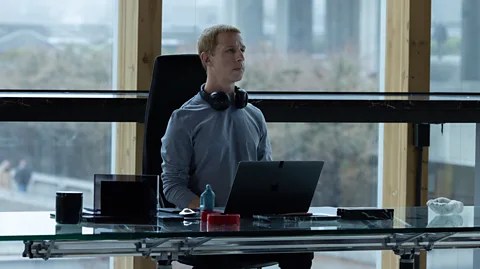
Intercut with their story is some insight into Mark Zuckerberg (Strong), the controversial and very public face of the organisation, as he works with his team to present himself and the company’s decisions in the best possible light amid preparations for a Senate hearing. Mark often butts heads with Charlie (Burr), who pushes him to moderate and fact-check political content to prevent harm from being caused down the road. This story thread culminates with Zuckerberg being confronted with difficult decisions in real time during the January 6 Capitol insurrection, spurred on by Donald Trump.
This is the kind of event that will be talked about for decades to come. The era of history when social media giants invaded our society and knowingly promoted the spread of violent, hate-filled rhetoric so they could keep people on the platform and expose them to advertisements. When a horde of angry citizens beat police officers with US flags and smashed their way into the Capitol building to smear their shit on the walls after being connected with like-minded people and coordinating through Facebook. The question facing this particular film is whether or not it is successful in packaging the story for the public, and whether or not it is powerful enough to effect real change in 2026. Going by the number of people at our screening who immediately opened their Facebook and Instagram apps to share their thoughts and feelings about the movie while the credits were still rolling, possibly not.
The Social Reckoning gets carried by the strength of the script and the performers. Sorkin has attracted an immensely talented cast who can emphasise the dread and horror that this story conjures up while humanising the people who are caught between wanting to do the right thing and protecting themselves. Jeremy Strong has done a remarkable job of embodying Mark Zuckerberg’s unusual physical presence and tics, but it’s a character with little to no insight into his character or personality. Unfortunately, the more accurate a depiction of Zuckerberg he creates, the more cartoonish he looks compared to the other actors. It’s a double-edged sword that Sorkin doesn’t always manage to walk, with one PowerPoint presentation scene feeling unintentionally comedic due to Zuckerberg being a real-life ghoul.

Bill Burr’s Charlie was an especially confusing character, as he appears not to be based on a real person. Charlie represents the side of good, an angry Jiminy Cricket who begs Zuckerberg to do the right thing and moderate political content, adopting an “I told you so” attitude during the January 6 scenes. With various representations of real people at the centre of the drama, “Charlie” feels like an author-insert point of view that undermines some of these serious discussions. This character, who gave up a billion dollars to do the right thing but also comes back to argue with Zuckerberg about it, could have been revealed as a heavenly messenger sent to give Zucks a Christmas Carol-style warning, and it wouldn’t have felt out of place.
Edited to add: it just occurred to us that the conceit of Frances disguising herself as an escort to meet with Jeff at his hotel seemed weird. He was the one recognisable to Facebook workers, and it never played into the story in any meaningful way. It also felt out of character for the what we’d seen before. Turns out this was a total fabrication of the movie. Weird one, that. Just wanted to put Madison in a slinky dress for a few scenes?
As we’ve emphasised in this review, this is an important story to be told. Without David Fincher’s immense skill at directing, it lacks the rapid-fire pace and creative storytelling that elevated The Social Network from an important story to a cultural touchstone that helped shape the public’s viewpoint of Zuckerberg and Facebook. Unfortunately, Sorkin lacks the experience and creative vision to achieve that high standard and only manages a competent, paint-by-numbers adaptation of his script. There are some clever editing choices in how we shift between the years in which the story takes place, and the narrative seeding of the January 6 rioters was immensely effective, but these are standouts rather than the consistent creativity Fincher can deliver. This film is 80% shot-reverse-shot of White and Madison talking at a picnic bench or in a hotel room. And although Sorkin has made a point of saying this isn’t a sequel to his previous Zuckerberg story, the marketing for this new effort clearly wants us to think that way.
Overall, a very good film with a great script and performances that could have been elevated into something truly impactful with a stronger hand on the camera.
Rating: SEVEN out of TEN


![Top 10 Creepy Cryptids [by Bea Harper]](https://i0.wp.com/houseofgeekery.com/wp-content/uploads/2016/10/cryptid.jpg?fit=1200%2C675&ssl=1&resize=40%2C40)


